PEB vs RCC Industrial Buildings: Cost, Time & Best Use Cases
Choosing the right structural system is one of the most critical decisions in any industrial project. A wrong choice can lock you into higher costs, longer timelines, and poor flexibility for future expansion.
For factories and warehouses in India, the debate usually comes down to PEB (Pre-Engineered Buildings) vs RCC (Reinforced Cement Concrete).
This blog breaks it down clearly, practically, and from an EPC contractor’s perspective—so you can choose what actually suits your operations, not just what’s cheaper on paper.
What Is a PEB (Pre-Engineered Building)?
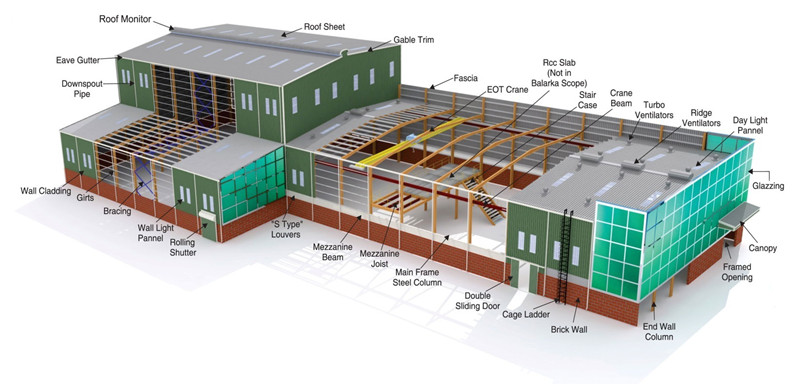
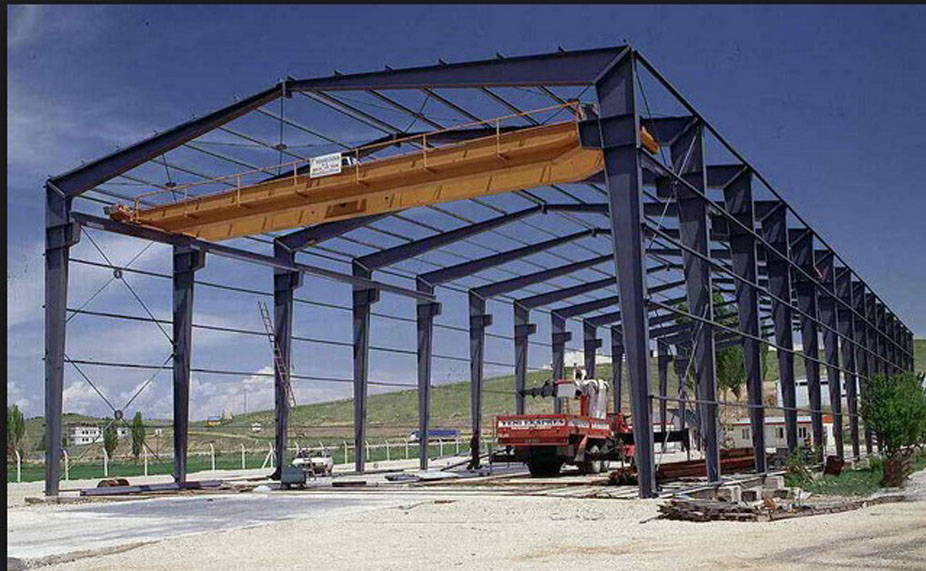
A PEB industrial building is a steel structure where:
- Primary frames are factory-fabricated
- Members are tapered and optimized for load
- Components are bolted on-site, not cast in place
Typical Uses
- Warehouses & logistics parks
- Light to medium manufacturing units
- Cold storage & distribution centers
- Industrial sheds with large clear spans
What Is an RCC Industrial Building?
An RCC industrial structure is constructed using:
- Cast-in-situ concrete columns, beams & slabs
- Brick/block masonry infill
- Heavier foundations and rigid framing
Typical Uses
- Heavy manufacturing plants
- Multi-storey factories
- Buildings with high vibration loads
- Industrial buildings with architectural façades
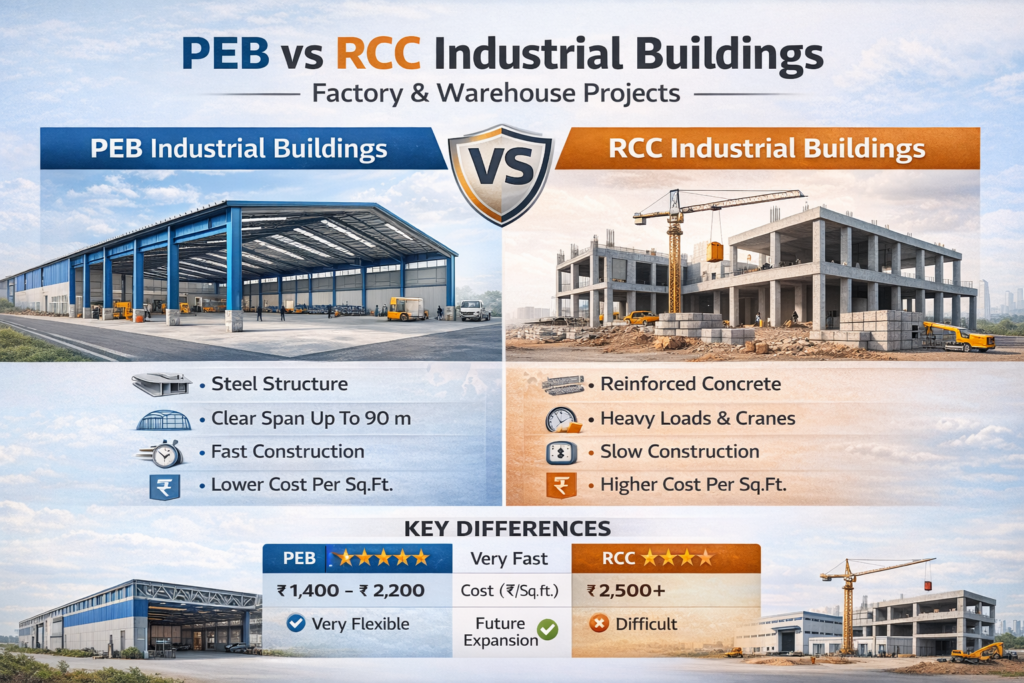
PEB vs RCC: Quick Comparison
| Parameter | PEB Industrial Building | RCC Industrial Building |
|---|---|---|
| Construction Speed | ⭐⭐⭐⭐⭐ Very fast | ⭐⭐ Slow |
| Cost (₹/sqft)* | Lower | Higher |
| Clear Span | Up to 90 m easily | Limited |
| Expansion Flexibility | Excellent | Difficult |
| Load Capacity | Medium–High | Very High |
| Foundation Size | Smaller | Larger |
| Maintenance | Low | Medium |
| Multi-storey Suitability | Limited | Excellent |
*Indicative; varies by location, height, loading & finishes.
Cost Comparison: PEB vs RCC (Indicative)
PEB Industrial Building
₹1,400 – ₹2,200 per sq.ft
Faster return on investment
Lower foundation and material wastage
RCC Industrial Building
₹2,500 – ₹4,000+ per sq.ft
Higher initial cost
Better for long-term heavy-duty use
👉 Key insight: For large single-storey warehouses, PEB is almost always more economical.
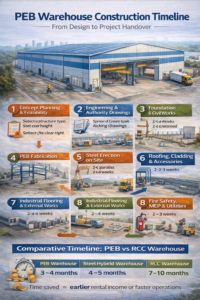
Construction Timeline Comparison
PEB Timeline
- Design & approvals: 3–5 weeks
- Fabrication: 4–6 weeks
- Erection & roofing: 4–6 weeks
Total: ~3–4 months
RCC Timeline
Excavation & foundations: 4–6 weeks
Superstructure: 4–5 months
Masonry & finishing: 2–3 months
Total: ~7–10 months
⏱ If time-to-market matters, PEB wins clearly.
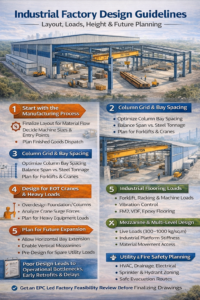
Structural Performance & Load Handling
Choose PEB if:
No heavy EOT cranes
Light to medium machinery
Large column-free spaces needed
Choose RCC if:
Heavy cranes (10T, 20T+)
High vibration equipment
Multiple floors required
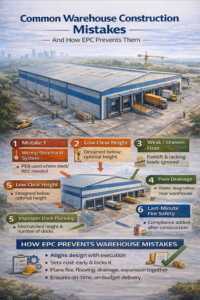
⚠️ Mistake to avoid: Using PEB where heavy crane loads exist without proper hot-rolled framing.
Future Expansion: A Critical Difference
PEB Expansion
- Easy bay extension
- Roof height modification possible
- Minimal shutdown during expansion
RCC Expansion
- Complex structural tying
- Heavy demolition
- Longer downtime
📈 For growing businesses, PEB offers unmatched flexibility.
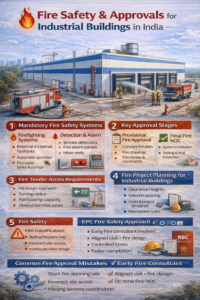
Fire Safety & Compliance
- PEB requires proper fireproofing, insulation & NBC compliance
- RCC offers inherent fire resistance
👉 With a competent EPC contractor, both systems can fully comply with statutory and fire norms.
When PEB Is the Right Choice
✔ Warehouses & logistics centers
✔ Single-storey factories
✔ Speed-critical projects
✔ Cost-sensitive developments
✔ Expansion planned in future
When RCC Is the Right Choice
✔ Heavy industrial plants
✔ Multi-storey factories
✔ High crane loads
✔ Long-life asset focus
✔ Architectural integration
EPC Perspective: The Smart Approach
Many successful industrial projects today use a hybrid model:
RCC foundations + pedestals
Steel / PEB superstructure
RCC mezzanines where needed
This delivers speed + strength + cost efficiency.
Final Verdict: PEB or RCC?
There is no universal winner.
The right choice depends on:
- Process loads
- Expansion plans
- Time constraints
- Budget & lifecycle cost
📌 That’s why EPC-led planning matters more than structure type alone.
Need Help Deciding?
If you’re planning a factory or warehouse and unsure whether PEB, RCC, or a hybrid solution suits you best:
👉 Get a free EPC feasibility review
👉 Compare cost, timeline & future expansion before locking your design
Choosing right at this stage can save months of time and crores in future modifications.