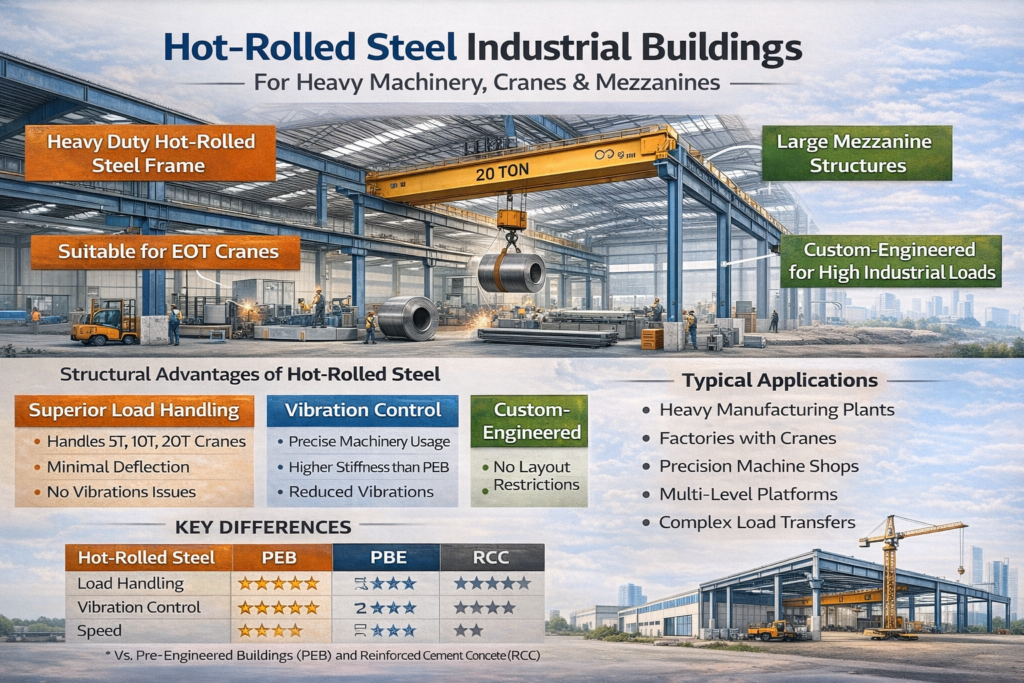
Hot-Rolled Steel Industrial Buildings: When PEB Is Not Enough
Not all industrial buildings are created equal.
While PEB (Pre-Engineered Buildings) work perfectly for warehouses and light manufacturing, they reach their limits when projects involve heavy cranes, high vibration machinery, large mezzanines, or complex load paths.
That’s where hot-rolled steel industrial buildings become the right—and often the only—engineering solution.
This blog explains what hot-rolled steel structures are, when they are required, how they compare with PEB and RCC, and how EPC-led planning makes them cost-effective.
What Is a Hot-Rolled Steel Industrial Building?
A hot-rolled steel structure uses:
- Rolled steel sections (ISMB, ISWB, ISHB, channels, angles)
- Heavy-duty connections (bolted + welded)
- Custom-designed frames based on actual loads—not standard modules
Unlike PEB, hot-rolled steel is not pre-optimized for light loads. It is engineered specifically for strength, stiffness, and durability.
When PEB Is Not Enough
PEB structures are efficient—but they are not suitable for every industrial application.
Hot-rolled steel is required when you have:
✔ EOT cranes (5T, 10T, 20T or more)
✔ Heavy vibration-producing machinery
✔ Large mezzanine floors with high live loads
✔ Multi-level industrial platforms
✔ Complex load transfers
✔ Irregular layouts or architectural constraints
⚠️ Common mistake: Trying to “force-fit” heavy crane loads into a PEB system to save cost—this often leads to deflection issues and future retrofits.
Typical Applications of Hot-Rolled Steel Buildings
- Heavy engineering & fabrication plants
- Automobile & ancillary factories
- Power & energy plants
- Foundries & machine shops
- Industrial buildings with cranes + mezzanines
- Process-driven manufacturing facilities
These buildings are load-dominated, not span-dominated.
Hot-Rolled Steel vs PEB vs RCC (Quick Comparison)
| Parameter | PEB | Hot-Rolled Steel | RCC |
|---|---|---|---|
| Crane Load Capacity | Limited | ⭐⭐⭐⭐⭐ | ⭐⭐⭐⭐ |
| Vibration Handling | Medium | ⭐⭐⭐⭐⭐ | ⭐⭐⭐⭐ |
| Speed of Construction | ⭐⭐⭐⭐⭐ | ⭐⭐⭐⭐ | ⭐⭐ |
| Structural Flexibility | Medium | ⭐⭐⭐⭐⭐ | Low |
| Cost Control (EPC) | High | High | Medium |
| Multi-Level Platforms | Limited | Excellent | Excellent |
Cost of Hot-Rolled Steel Industrial Buildings (India)
Indicative Cost Range (2026)
₹2,200 – ₹3,200 per sq.ft
Cost Depends On:
- Crane capacity & duty class
- Column spacing & clear height
- Mezzanine loads
- Connection detailing
- Fire protection requirements
💡 Key insight: Though costlier than PEB, hot-rolled steel is often cheaper than RCC for heavy industrial use—especially when time and flexibility are considered.
Structural Advantages of Hot-Rolled Steel
1️⃣ Superior Load Handling
- Designed for actual operational loads
- Minimal deflection under crane movement
2️⃣ Vibration Control
- Better stiffness compared to PEB
- Suitable for precision machinery
3️⃣ Custom Engineering
- No restriction on bay size or layout
- Ideal for process-based factories
4️⃣ Faster Than RCC
- Steel fabrication runs parallel to foundation works
- Less curing time, faster commissioning
Foundation Strategy: Hybrid Is the Smart Choice
Most EPC projects use a hybrid solution:
- RCC foundations & pedestals
- Hot-rolled steel superstructure
- RCC floors / mezzanines where required
This balances:
✔ Strength
✔ Speed
✔ Cost
✔ Expandability
Fire Safety Considerations
Hot-rolled steel requires:
- Intumescent coatings or fireproofing
- Fire-compliant structural design
- Proper evacuation & service integration
📌 With EPC planning, fire compliance is integrated early—avoiding late-stage cost escalation.
EPC Perspective: Why Hot-Rolled Steel Needs EPC Execution
Hot-rolled steel buildings must be EPC-driven because:
- Design and execution are tightly linked
- Connection detailing affects cost & performance
- Poor coordination leads to delays and rework
An EPC contractor ensures:
✔ Structural optimization
✔ Vendor coordination
✔ Site-ready fabrication drawings
✔ Faster erection with fewer clashes
When Should You Choose Hot-Rolled Steel?
Choose hot-rolled steel if:
✔ You have cranes or heavy machinery
✔ Structural vibration matters
✔ Layout is complex or process-driven
✔ You want long-term adaptability
✔ PEB feels “under-designed”
Final Thoughts: Right Structure = Right Performance
Hot-rolled steel industrial buildings are not overkill—they are purpose-built solutions for demanding industrial environments.
Choosing the right structure at planning stage:
- Prevents retrofits
- Improves safety
- Reduces downtime
- Protects long-term operations
Planning a Heavy Industrial Building?
Before finalizing PEB or RCC, get a structural feasibility review that compares:
- PEB vs hot-rolled steel vs RCC
- Cost, time & operational performance
- Crane & mezzanine readiness
A single design decision today can define your factory’s performance for decades.