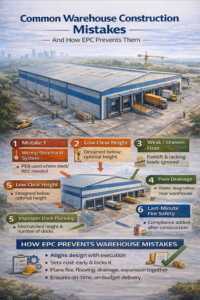
Industrial projects fail or succeed not because of drawings—but because of coordination. Delays in approvals, design mismatches, procurement gaps, and execution errors are exactly why many factory and warehouse projects go over budget and miss deadlines.
That’s where the EPC model (Engineering, Procurement & Construction) becomes a game-changer.
This blog explains the end-to-end EPC model for industrial buildings, how it works in practice, and why developers and industrial owners increasingly prefer EPC over traditional contracting.
What Is the EPC Model?
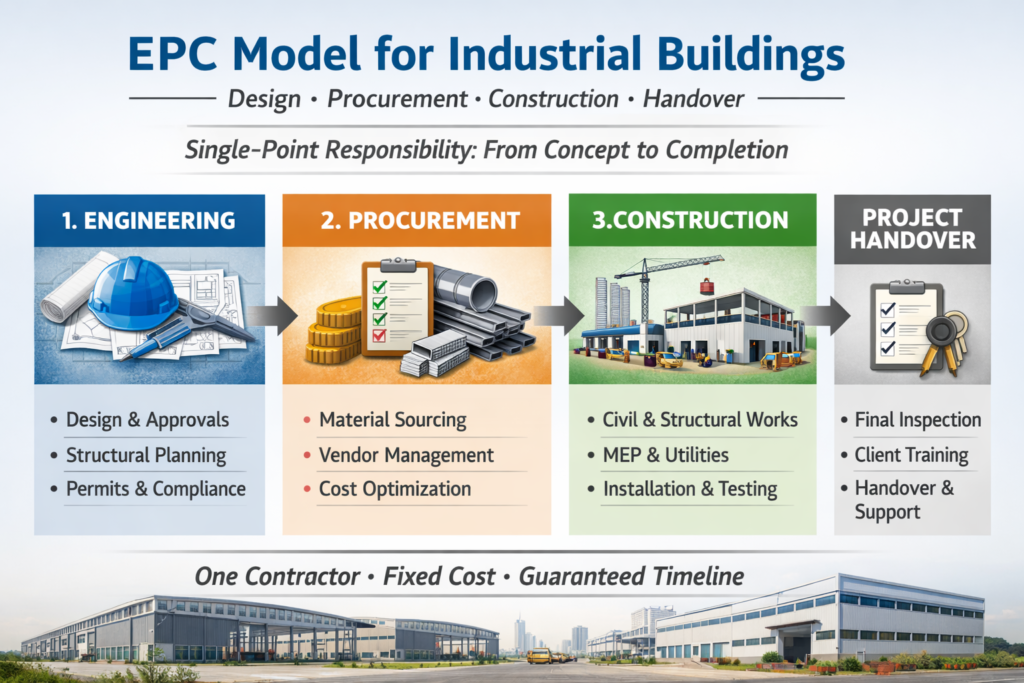
The EPC model is a single-point responsibility contract where one entity is accountable for:
- Engineering (design & approvals)
- Procurement (materials & vendors)
- Construction (execution & handover)
Instead of managing multiple consultants and contractors, the client deals with one EPC contractor responsible for cost, time, quality, and coordination.
Why EPC Is Ideal for Industrial Buildings
Industrial projects are process-driven, not just architectural. EPC works best where:
- Structural loads are critical
- Timelines affect revenue
- Services must integrate seamlessly
- Expansion planning is important
Typical EPC industrial projects include:
- Warehouses & logistics parks
- Factories & manufacturing plants
- PEB & steel structures
- RCC industrial buildings
EPC vs Traditional Contracting (Quick View)
| Aspect | Traditional Model | EPC Model |
|---|---|---|
| Design Responsibility | Client / Consultant | EPC Contractor |
| Procurement | Client / Multiple Vendors | EPC Contractor |
| Execution | Multiple Contractors | Single Contractor |
| Coordination | Client-managed | EPC-managed |
| Cost Risk | Client | EPC Contractor |
| Timeline Control | Weak | Strong |
👉 EPC reduces risk for the client and increases accountability.
Stage 1: Engineering (Design & Approvals)
This is the foundation of a successful EPC project.
What Engineering Includes
- Site study & feasibility
- Structural system selection (PEB / RCC / steel)
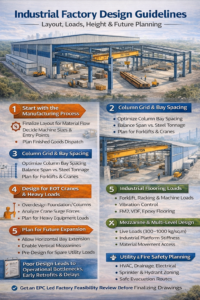
- Load calculations (machinery, cranes, storage)
- Layout optimization & future expansion planning
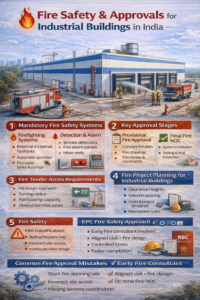
- Statutory & fire compliance drawings
📌 Key EPC advantage: Design decisions are made with execution and cost in mind—not in isolation.
Stage 2: Procurement (Materials & Vendors)
Procurement is where many projects lose control.
EPC Procurement Covers
- Structural steel / PEB systems
- Cement, reinforcement & concrete
- Roofing, cladding & insulation
- Flooring systems
- MEP, fire & utility packages
✔ Centralized vendor control
✔ Optimized specifications
✔ Bulk pricing benefits
✔ Just-in-time delivery
📉 Result: Reduced wastage, better quality, controlled costs.
Stage 3: Construction (Execution & Coordination)
This is where EPC truly shines.
EPC Construction Scope
- Site mobilization & planning
- Civil & foundation works
- Structural erection (steel / RCC)
- Roofing, cladding & flooring
- MEP, fire & utility integration
- Testing, commissioning & handover
Because design and procurement are already aligned:
- Fewer site clashes
- Faster execution
- Minimal rework
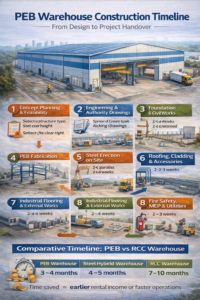
⏱ Industrial EPC projects typically save 15–30% time.
Single-Point Responsibility: The Biggest Advantage
In EPC:
- One contract
- One responsibility
- One accountable entity
If something goes wrong:
- No blame-shifting between designer, vendor, and contractor
- EPC contractor owns the solution
💡 This is critical for industrial clients who want certainty.
Cost & Time Certainty in EPC
Cost Control
- Defined scope upfront
- Value engineering during design
- Optimized procurement
Time Control
- Parallel activities (design + procurement)
- Factory-fabricated components
- Pre-planned execution sequences
📊 EPC typically reduces:
- Cost overruns
- Change orders
- Project uncertainty
EPC Model for PEB vs RCC Industrial Buildings
EPC + PEB
- Faster execution
- Ideal for warehouses
- Expansion-friendly
EPC + RCC
- Heavy load handling
- Multi-storey factories
- Long-term durability
Many projects use a hybrid EPC approach:
- RCC foundations & cores
- Steel / PEB superstructure
Common Myths About EPC
❌ EPC is more expensive
✔ Reality: EPC often reduces overall lifecycle cost
❌ EPC reduces client control
✔ Reality: EPC simplifies decision-making
❌ EPC suits only large projects
✔ Reality: EPC works even for mid-scale warehouses
When Should You Choose EPC?
Choose EPC if:
✔ You want time certainty
✔ You want cost control
✔ You don’t want to manage multiple vendors
✔ You plan future expansion
✔ You want execution-driven design
Final Thoughts: EPC Is About Accountability
The EPC model is not just a contract format—it’s a delivery philosophy.
For industrial buildings where:
- Every delay costs money
- Every design mistake affects operations
- Every coordination failure causes rework
👉 End-to-end EPC is the smartest approach.
Planning an Industrial Project?
Before finalizing consultants or structure type, get an EPC feasibility review that covers:
- Structural system selection
- Cost & timeline comparison
- Expansion readiness
A well-planned EPC project can save months of time and significant capital—right from day one.